
Manner and Technique
Noel de Lesseps’ Twilight Chymical Conjunction at Entrance


March 14, 2026 | by Anna Gregor | perseity.nyc
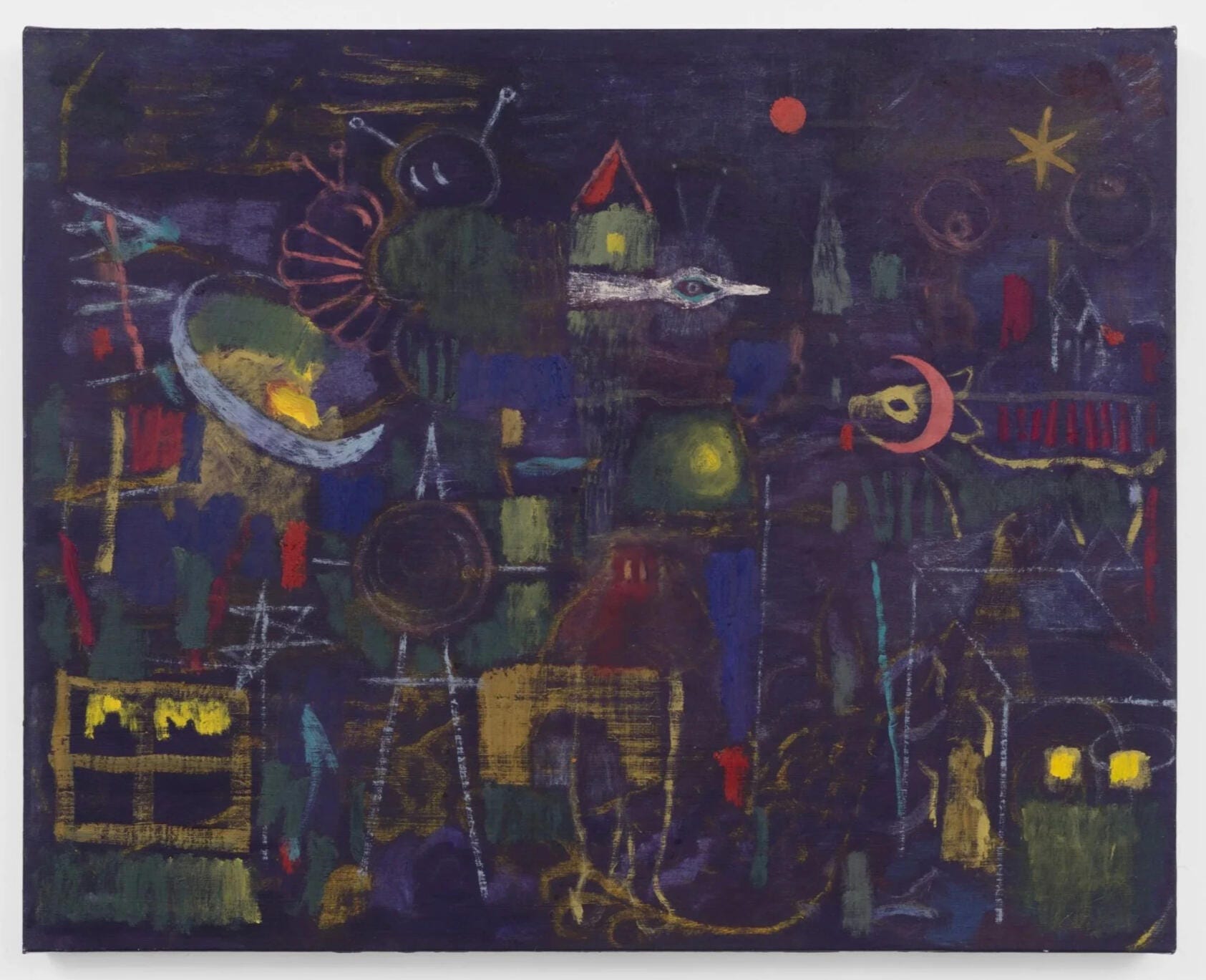
Noel de Lesseps, Arc en ciel, 2024. Oil on linen, 16 x 20 inches.
“He’s completely self-taught. He’ll just get obsessed with a technique and delve deeper and deeper into it.”
—or some such malarkey was overhead at the opening of Noel de Lesseps’ exhibition at Entrance, likely pitched over and over again to prospective collectors throughout the evening.
What “techniques” de Lesseps delves into, and what depths he reaches, is not immediately apparent in the paintings in the show, which are generally painted flatly and dryly with little medium or variation in application, their palettes within a narrow range of slightly more or less desaturated color. But it’s not a lack of technique or artistic “training” that moves me to write about this show over any of the other middling painting shows I saw that night, many of which exhibited some degree of “technique,” as the term is generally used. It is, rather, the pretension that being “self-taught” is, firstly, at all extraordinary in today’s artworld and, secondly, that such a self-taught state of the artist inherently imbues an otherwise predictable product with meaning. De Lesseps’ branding as self-taught (whether his choice of adjective or some gallerist’s who saw its pitch potential and planted it in his bio) is a mere rehashing of the romantic fetishization of the “primitive” that modernists get so much flack for, translated into a less offensive term and applied to the 21st century Bushwick Boy™, the New York City artworld’s imaginary primitive: naïve, unrepressed, directly expressive, and somehow closer to nature than those of us hemmed in by convention.
The truth is, today every true artist must be self-taught. Admittedly, this formulation misleads, placing, as it does, the emphasis on the person who made the work rather than on the artworks themselves. Better: Every true artwork is a self-teaching.
Visit almost any MFA program. The supposedly trained students have likely never completed the exercises we imagine artistic training to entail (say, mixing a scale of chromatic greys from complementary colors or learning how to sight with a pencil while drawing observationally). And if an odd student chanced to have gone to an undergraduate program that hadn’t deskilled its curriculum (whether the curriculum committee was motivated by a romantic picture of direct expression or was simply resentful of the training they had to endure without seeing any use for it), the MFA candidate has probably forgotten it all by now. Such training is no longer a prerequisite for making art. (“My kid could do that!”) This is not news. Ryman made Twin, the all-white painting in MoMA’s collection,* sixty years ago*. Considering that a urinal bought on 5th Avenue has been considered art for at least as long, there is no reason that an art student must learn (traditional, Western European) techniques (but, likewise, no necessity that they shouldn’t). Twin, although it is just white paint applied to cotton duck, taught Ryman, and teaches a viewer, how much there is to see in what we first thought to be an “empty” painting—and it does so itself (not because wall plaques never tire of telling us that Ryman was a trained jazz musician) in how the paint is applied by hand with a single flat brush at a specific angle, how a thread-thick border of canvas remains unpainted at the turning edge, how the corners are folded like a pinwheel: every decision matters. So each artist must teach themselves, must learn the technique proper to each painting every time they paint.
It doesn’t matter whether they avoided an institutionalized art education altogether, or attended Parsons (where they, like myself, would have received absolutely no training in anything other than late 1990s art-theoretical jargon), or studied at a more traditional school like The New York Academy of Art or the Grand Central Atelier (which nominally teach technique by imposing academic restraints on painting through a specific manner of drawing, color theory, and paint manipulation). In a time when anything can be art (but clearly not everything is) there can be no technical givens. Making an artwork entails surpassing what has been received rotely, overcoming one’s education and/or lack thereof. Being self-taught is the necessary condition of artists today and in no way means that those without a so-called art education are closer to direct expression (that romantic hallucination) because (supposedly) not corrupted by the imposition of conventional techniques.
“Technique” in art is not a mere mode of manipulating matter. That is the type of technique proper to an assembly line (which accounts for why someone might, mistakenly but understandably, take an absence of technical training to be promising in an artist). But technique, in an artistic sense, must be expanded to mean something closer to discovery: the discovery of coherence that arises when matter and mind form and inform each other until part is related to whole in a way that the artist couldn’t have predicted the piece before it was finished. In art, any mode of manipulating material that is not this special kind of artistic technique is mannerism: pretension to meaning through the repetition of what were once, maybe, in other hands, significant relations, settling for an old, cold, coherence rather than a new one. Its product looks like art, but is not. It’s merely in the manner of art (which—good news for galleries!—doesn’t mean it won’t sell).
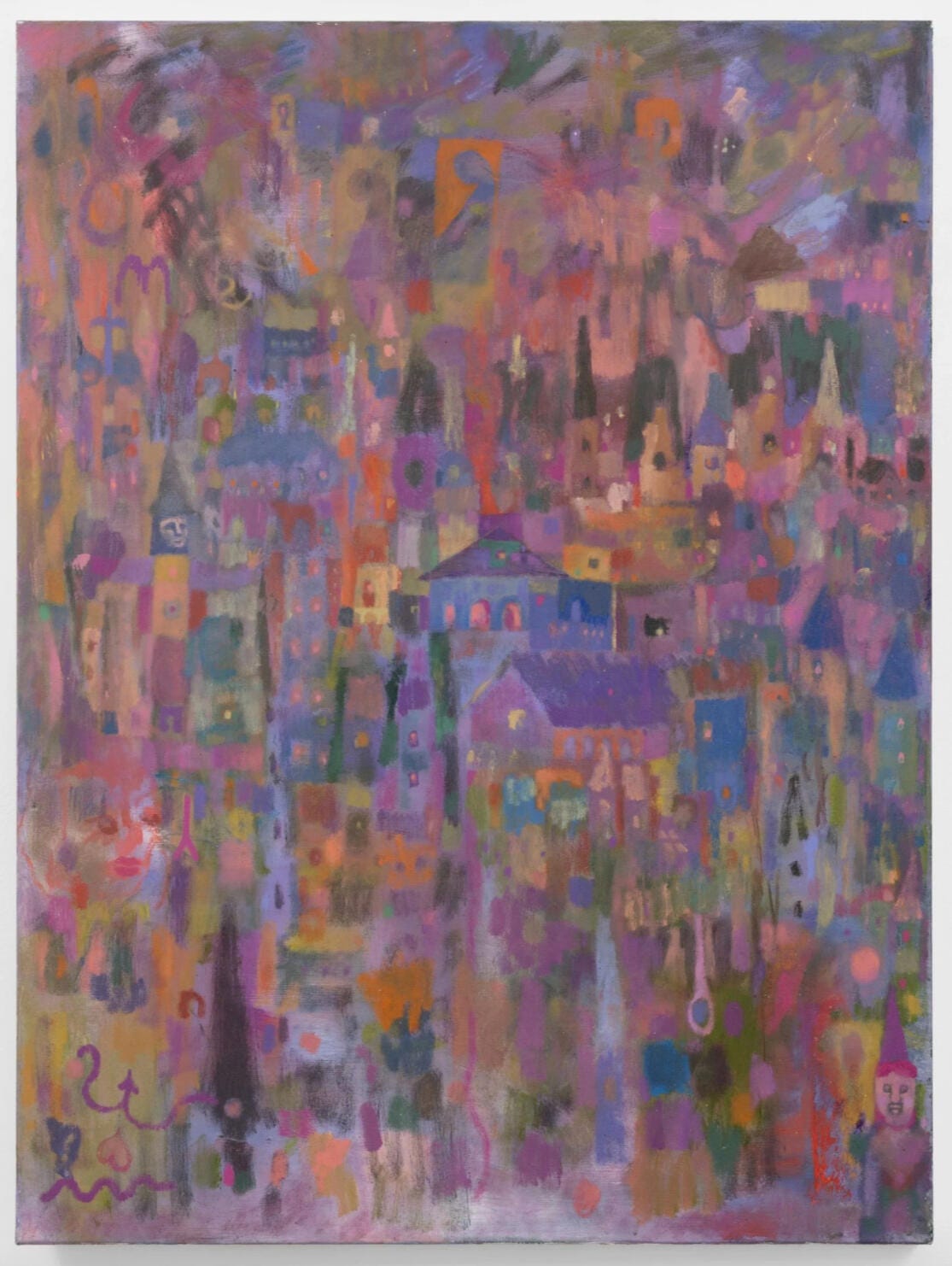
Noel de Lesseps, Little light, 2025. Oil on canvas, 30 x 40 inches.
In art, the opposite of “self-taught” is not “technically trained” (as the overheard quote that ignited this essay presupposes) but “mannered.” A painting can be in the manner of one who is “self-taught”, in the style of naïveté, as in the case de Lesseps’. But this is the opposite of self-taught, in an artistic sense. Paintings made by a truly “primitive” native of the 21st century, untainted by fine artistic conventions (were we to buy the romantic’s picture of expression), would surely produce works that look more like fanart or memes than the influences of Klee, Kandinsky, and Miro present in Lessep’s palettes and compositions (modernists who themselves were working in the manner of children, cave painters, and asylum patients, and whose work is only successful when it overcomes these mannerisms and, far from reverting to some primitive mode of expression, discovers new coherences in the process of making). Unless an artwork is a discovery, it is not an artwork. When nothing is learned (by artist or viewer) the painting is dead.
“Self-taught” is a term applied to the empirical person Noel de Lesseps in bio or spiel, but what does that do to our viewing experience? Their surfaces are not that nice, but not unsettling enough to keep looking (it is difficult to make an unsettling painting in the way that Klee’s surfaces so often manage); the surreal-ish scenes of figures with their dicks out amidst Kandinsky-ish landscapes are kind of charming, but give rise to neither narrative nor formal significance; the scenes are full of juxtapositions of esoteric objects and symbols, but none relate to the others to give rise to significance worth spending much time on—not because, as the press release claims, “Characters engage and questions arise, but not to be answered,” but, conversely, because little engages and few questions arise (hence the need to qualify that the artist is “self-taught”).
And, if it lightens the blow of this essay, I admit that there are inklings of true self-education in a few of the paintings. Take Appearance (2025). The color choices are odd (it is difficult to make that ultramarine violet work in any painting, but especially next to the dull intensity of chromium oxide green and cadmium orange), yet the compression of striation and patch, the mutual repellence of light and dark values in top and bottom halves respectively, the stacking of space, the visual dismemberment of the giant bunny… somehow hold it together. It is a reminder that we need not brand ourselves as self-taught, because that is the surest way to stunt our own education (that ever-continuing self- and other-education that an artist must commit to to even attempt to make art at all).
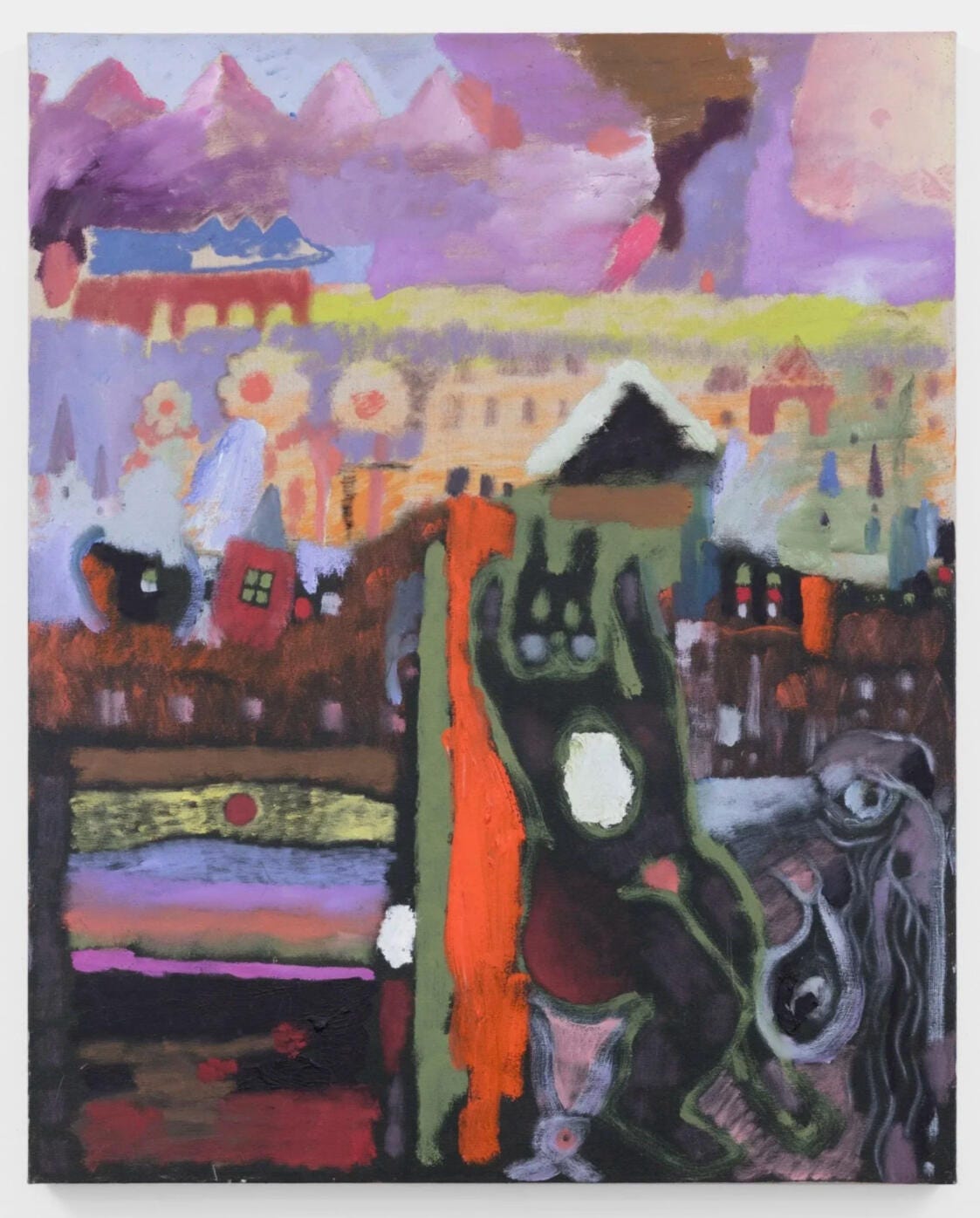
Noel de Lesseps, Appearance, 2025. Oil on linen, 24 x 30 inches.
Noel de Lesseps, Twilight Chymical Conjunction, Entrance, 48 Ludlow Street, NYC, Ground & Lower Level. March 12 – April 18, 2026.
 | A guest post by
|
i spent 10 years teaching myself to paint in oil. there weren't nearly as many guidebooks then (& a lot of what they said was wrong). i never managed to make something that another person would pay money for, but it was an enjoyable & enlightening excursus.